
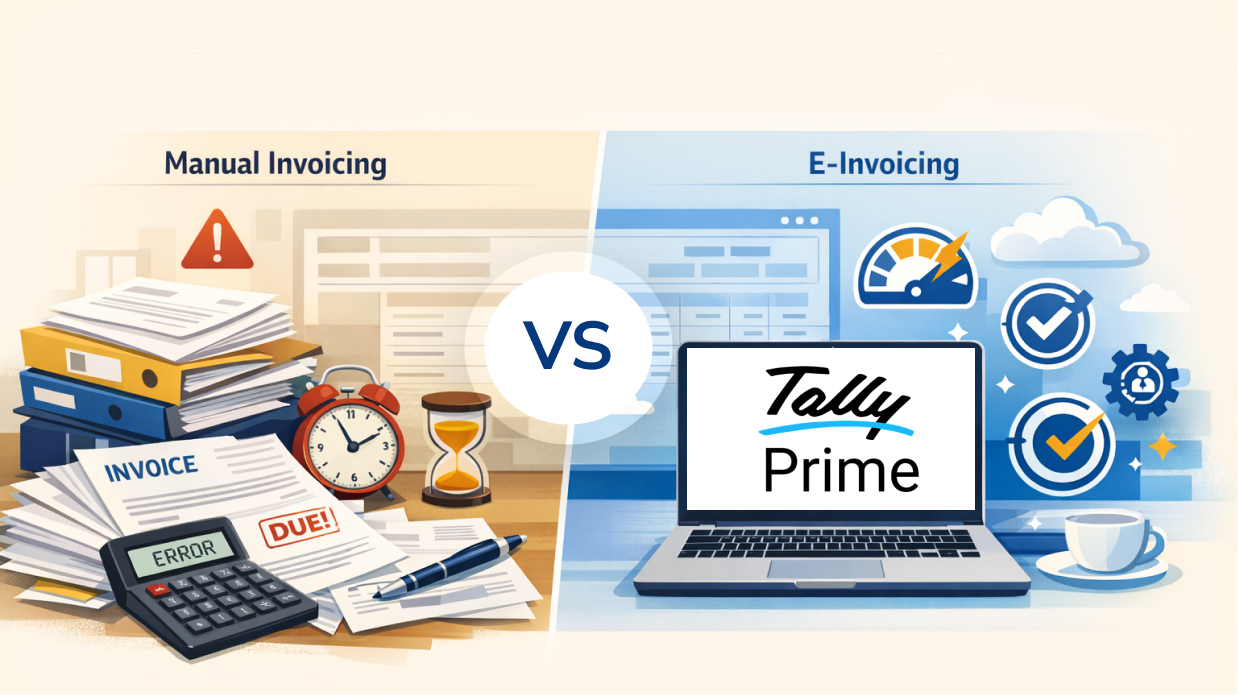
Invoicing plays a foundational role in business operations, influencing everything from revenue tracking to statutory compliance. With the introduction of GST in India, invoicing is no longer just about billing it is about accuracy, transparency, and regulatory alignment.
Tally continues to be one of the most trusted accounting platforms for Indian businesses, especially SMEs. It offers both manual invoicing and e-invoicing capabilities, allowing businesses to operate based on their current needs while preparing for future growth. Working with a Tally Certified Partner further ensures that businesses can leverage the full potential of Tally with proper configuration and compliance alignment.
However, as compliance requirements tighten and businesses scale, choosing the right invoicing method becomes a strategic decision rather than a routine preference.
What is Manual Invoicing in Tally
Manual invoicing in Tally refers to the traditional process where invoices are created within the system without any real-time integration with government portals. All entries from customer details to tax calculations are handled manually.
This method is straightforward and has been widely used by small businesses for years. It provides flexibility and does not require advanced technical setup. However, as transaction volumes increase, the limitations of manual invoicing become more visible.
Common characteristics of manual invoicing include:
- Full control over data entry and formatting
- No automatic validation with GST systems
- Dependence on manual reconciliation during return filing
While suitable for basic operations, this approach demands consistent accuracy and discipline from the accounting team.
What is e-Invoicing in Tally
e-Invoicing in Tally is a system-driven approach where invoices are generated and validated through integration with the GST Invoice Registration Portal (IRP). Each invoice is authenticated before being finalized, ensuring compliance from the outset.
Once an invoice is created, it is automatically sent to the IRP, where it is validated and assigned a unique IRN along with a QR code. This process ensures that the invoice is legally compliant and ready for reporting.
The key advantage of e-invoicing lies in its automation. Instead of relying on manual checks, the system ensures accuracy and consistency, reducing the burden on accounting teams.
Key Differences Between Manual and e-Invoicing
The difference between manual invoicing and e-invoicing is not just technical, it reflects a shift from reactive to proactive compliance.
Manual invoicing relies on internal processes, which can vary in accuracy depending on the user. e-Invoicing, on the other hand, introduces a standardized and validated approach.
The core differences can be understood in terms of:
- Process: Manual vs system-integrated
- Accuracy: Human-dependent vs system-validated
- Compliance: Post-check vs real-time validation
- Scalability: Limited vs growth-ready
These differences become increasingly important as businesses expand and regulatory scrutiny increases.
Advantages and Limitations of Each
Manual invoicing remains relevant for businesses that prioritize simplicity and operate at a smaller scale. It allows quick implementation and does not require dependency on external systems.
However, it comes with certain drawbacks. As the volume of transactions increases, maintaining accuracy becomes more challenging. Errors in GST details or calculations can lead to compliance issues and additional workload during reconciliation.
e-Invoicing, in contrast, offers a structured and efficient approach. It significantly reduces manual effort and ensures that invoices are compliant from the moment they are generated.
Its advantages are especially noticeable in areas such as:
- Reduced data entry errors
- Faster invoice processing
- Improved GST reporting accuracy
While there may be an initial learning curve, the long-term operational benefits make it a valuable investment.
Compliance and GST Impact
GST compliance is one of the strongest arguments in favor of e-invoicing. Inaccurate invoices can lead to mismatches, penalties, and delays in filing returns.
With manual invoicing, businesses often face challenges such as incorrect GSTIN entries, inconsistent tax calculations, and delayed reconciliation. These issues can accumulate over time, increasing compliance risks.
e-Invoicing addresses these concerns by validating invoice data in real time. This ensures that:
- Invoice details are accurate and consistent
- GST returns are aligned automatically
- Audit risks are significantly reduced
For businesses in Gujarat, particularly in Vadodara, where regulatory checks are frequent, maintaining compliance is not optional, it is essential.
Business Efficiency & Automation Benefits
Efficiency is a critical factor for any growing business. Manual invoicing, while manageable initially, often becomes time-consuming and resource-intensive as operations expand.
e-Invoicing introduces automation into the workflow, allowing businesses to streamline their processes. This leads to faster invoice generation, improved accuracy, and better resource utilization.
In practical terms, businesses that adopt e-invoicing often experience:
- Faster turnaround time for invoicing
- Reduced workload on accounting teams
- Better visibility into financial data
For SMEs in Vadodara, this shift can significantly enhance productivity and support long-term scalability.
Which Option is Better for Different Business Types
The choice between manual invoicing and e-invoicing depends on the nature and scale of the business.
Small businesses with limited transactions may continue using manual invoicing for simplicity. However, they should remain prepared for future transitions as compliance requirements evolve.
Medium-sized enterprises benefit greatly from e-invoicing due to increasing transaction volumes and the need for accuracy and efficiency.
For large enterprises, e-invoicing is not just beneficial, it is essential. It ensures compliance, supports high transaction volumes, and integrates seamlessly with broader financial systems.
Role of Tally Experts in Implementation
Adopting e-invoicing requires more than just enabling a feature; it requires proper configuration, compliance alignment, and user training.
A Tally Certified Partner ensures that the system is implemented correctly and adheres to GST regulations. A Tally Authorised Partner provides structured guidance, helping businesses transition smoothly from manual processes.
Additionally, working with a reliable Tally Dealer ensures that your software environment remains updated, secure, and fully supported.
Expert involvement minimizes errors during implementation and maximizes the return on investment.
Local Service Advantage
Choosing a local Tally service provider in Vadodara adds significant value, especially for businesses that require timely support and personalized solutions.
Local providers offer:
- Faster response times for technical issues
- Better understanding of regional GST practices
- On-site assistance when required
Vadodara’s dynamic business environment demands quick decision-making and reliable support systems. A local expert can bridge the gap between technology and practical business needs more effectively than remote services.
Conclusion
The transition from manual invoicing to e-invoicing in Tally reflects a broader shift toward digital transformation in business operations. While manual invoicing may still serve basic requirements, it lacks the efficiency, accuracy, and compliance capabilities needed in today’s regulatory landscape.
e-Invoicing offers a future-ready solution that enhances operational efficiency, reduces compliance risks, and supports business growth. It is not merely a technological upgrade but a strategic investment in long-term sustainability.
However, the success of this transition depends heavily on proper implementation and ongoing support. Businesses that work with experienced professionals gain a significant advantage in terms of system optimization and compliance readiness.
For organizations in Vadodara and across Gujarat, partnering with a trusted Tally Partner ensures not just technical excellence, but also reliability, continuity, and long-term business value.
Frequently Asked Questions (FAQs)
2. What are the benefits of using e-invoicing for growing businesses?
e-Invoicing improves efficiency, reduces manual work, ensures compliance, and supports scalability, making it ideal for businesses with increasing transactions.
3. Can small businesses continue using manual invoicing in Tally?
Yes, small businesses with low transaction volumes can use manual invoicing, but switching to e-invoicing helps improve accuracy and future scalability.
4. How does e-invoicing improve GST compliance?
e-Invoicing validates invoices in real time through the GST system, reducing errors, ensuring correct data, and simplifying return filing and reconciliation.
5. Does e-invoicing reduce accounting errors?
Yes, e-invoicing minimizes human errors by automating calculations and validations, ensuring accurate GST details and reducing mismatches in returns.